Archive for the ‘History’ Category

Nick Crane’s Britannia and Floating Islands in Snowdonia, Wales

Tuesday, July 27th, 2010

Watched the first episode of Nick Crane’s Britannia, about England and Wales, and was interested to see a section about Snowdonia which implied that William Camden, the Elizabethan author of the original Britannia, had said that there were was a lake there which had a floating island in it. It implied that Camden would have come across this story by talking to cattle farmers of the area on his travels through North Wales. But that doesn’t seem to be the case at all, in fact the English translation of Camden’s own text says:

Neverthelesse, so ranke are they with grasse that it is a very comon speech among the Welsh, that the mountaines Eriry will yeeld sufficient pasture for all the cattaile in Wales, if they were put upon them together. Concerning the two Meare [lakes] on the toppe of these, in the one of which floteth a wandering Island, and in the other is found great store of fishes, but having all of them but one eye apeece, I will say nothing lest I might seeme to foster fables, although some, confident upon the authority of Giraldus, have beleeved it for a verity.

In other words he was just quoting Giraldus Cambrensis who, in his “The Description of Wales” (1194 CE), wrote:

the latter of which are said to be of so great an extent, that if all the herds in Wales were collected together, they would supply them with pasture for a considerable time. Upon them are two lakes, one of which has a floating island; and the other contains fish having only one eye, as we have related in our Itinerary.

Even then Giraldus is just summarising what he wrote in his “The Itinerary of Archbishop Baldwin through Wales” (1188 CE), where he says:

On the highest parts of these mountains are two lakes worthy of admiration. The one has a floating island in it, which is often driven from one side to the other by the force of the winds; and the shepherds behold with astonishment their cattle, whilst feeding, carried to the distant parts of the lake. A part of the bank naturally bound together by the roots of willows and other shrubs may have been broken off, and increased by the alluvion of the earth from the shore; and being continually agitated by the winds, which in so elevated a situation blow with great violence, it cannot reunite itself firmly with the banks. The other lake is noted for a wonderful and singular miracle. It contains three sorts of fish – eels, trout, and perch, all of which have only one eye, the left being wanting; but if the curious reader should demand of me the explanation of so extraordinary a circumstance, I cannot presume to satisfy him.

So sadly it appears that William Camden was just referring back to a text that was almost 400 years old when the first edition of Britannia was published in 1586.

The Tragedy of War

Friday, April 16th, 2010

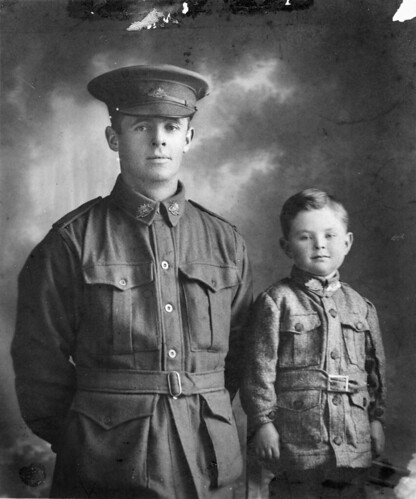
From the Australian War Memorial uploads to the Flickr Commons project.

Studio portrait of 1626 Private (Pte) Walter Henry Chibnall, 10th Light Trench Mortar Battery, pictured with his son William Beresford (Billy) Chibnall

Studio portrait of 1626 Private (Pte) Walter Henry Chibnall, 10th Light Trench Mortar Battery, pictured with his son William Beresford (Billy) Chibnall. [...] He was killed in action at Passchendaele, Belgium, on 12 October 1917, aged 32 [...] Pte Billy Chibnall enlisted during the Second World War, serving with the 2/21st Battalion. He was taken prisoner of war and died, aged 30, on 20 February 1942 at Ambon.

Very sad.

Retronaut: Siege of Leningrad

Sunday, March 7th, 2010

The ever fantastic “How to be a Retronaut” website has posted a brilliant collection of colour images of modern Leningrad which have been matched to, and partially overlaid with, black & white photos of the Siege of Leningrad during World War 2.

Russian soldiers escorting German PoW's during the siege of Leningrad

The collection has been put together by Segei Larenkov.

UK Academic Network JANET to Close Usenet News Service (Updated)

Wednesday, February 10th, 2010

This is a great shame, though probably not that surprising these days, but the UK Joint Academic Network (JANET) is going to pull its Usenet News service on the 31st July 2010. Basically I suspect the ever declining SNR has put people off, and these days everyone knows the web and the closest they get to knowing what Usenet is (or maybe was) Google Groups. JANET says:

There are now few active registered News Feed users and News Read users and the current infrastructure is nearing its end of life. JANET(UK) have therefore decided that it is no longer economically viable to run the service, especially in the current financial climate. We therefore will cease to offer the service when the existing contract expires on July 31st 2010.

Especially sad for me as I cut part of my first real sysadmin job at the University of Wales, Aberystwyth, was working on the Usenet news system that had been set up originally by Alec Muffett and I was for quite a while the maintainer of the UK.telecom newsgroup FAQ and the alt.config guidelines.

Update: I’ve been digging through some old email – here’s one from 4th August 1993 giving an idea of what we had to struggle with:

OK, I deleted all binaries under alt.binaries, all of junk and all of control. That, coupled with the AEM_TIDY got us about 27 meg back. I then ran a doexpire, whch took a long while but we’re now up to about 53 Meg free, or about 85% of the 400 Meg partition.

Yup, the entire university news spool at that time was a whopping great 400MB. ;-) We were using nntplink with CNews for the time (this was before we knew about INN).

Great Quote on Early Computing

Sunday, September 13th, 2009

Found this great quote whilst reading up more about Alan Turing being the first person to really comprehend what a modern computer would be like, a quote by Howard Aiken (of Harvard Mark I fame) in 1956 (the year after Turing’s death):

If it should turn out that the basic logics of a machine designed for the numerical solution of differential equations coincide with the logics of a machine intended to make bills for a department store, I would regard this as the most amazing coincidence that I have ever encountered.

Luckily Turing was right and he was wrong.. ;-)

Redacted NSA Cold War History Released

Saturday, January 3rd, 2009

Via Bruce Schneier, a redacted version of the NSA’s American Cryptology during the Cold War, (1945-1989) has been released thank to a request from the George Washington Universities National Security Archive project.

It includes a rather interesting section (book 1, pages 18 and 19) on how, in 1947, the UK foreign intelligence agency, SIS, decrypted some KGB messages from Canberra that turned out to include classified UK intelligence military estimates. This caused the US to break off crypto intelligence sharing with Australia putting the British in an awkward situation; as Clement Attlee put it:

The intermingling of American and British knowledge in all these fields is so great that to be certain of of denying American classified information to the Australians, we should have to deny them the greater part of our own reports. We should thus be placed in a disagreeable dilemma of having to choose between cutting of relations with the United States in defence questions or cutting off relations with Australia.

It took 5 years, the establishment of ASIO and a change in government from Chifley to Menzies before the US would reestablish full resumption of cryptologic exchanges with Australia and the author of the history concludes that this has a very bad effect on early American intelligence efforts against China.

The cause of the original leak to the KGB ? Two “leftists” in the Australian diplomatic service…

Dulce et Decorum

Wednesday, November 12th, 2008

Today is the 90th anniversary of the end of the First World War, a horrific slaughter of youth from across the world in the name of politics, alliances and patriotism.

If in some smothering dreams you too could pace
Behind the wagon that we flung him in,
And watch the white eyes writhing in his face,
His hanging face, like a devil’s sick of sin;
If you could hear, at every jolt, the blood
Come gargling from the froth-corrupted lungs,
Obscene as cancer, bitter as the cud
Of vile, incurable sores on innocent tongues,–
My friend, you would not tell with such high zest
To children ardent for some desperate glory,
The old Lie: Dulce et decorum est
Pro patria mori.

Wilfred Owens writing from the front.

Lest we forget..

First Australians

Sunday, November 2nd, 2008

Just wrote an email to an old friend in the UK and this is what I wrote about the SBS docco “First Australians” that has just finished. If you’ve not watched it already please go and watch it on the SBS website or pick up the DVD when it hits the SBS shop in December.

There’s been a really good series on TV here called “First Australians“, it gives the indigenous point of view of their history since the British landed and it’s been pretty heavy stuff. Whilst I knew a bit about the colonisation, killings, poisonings, repression, racism and the Stolen Generation the sheer scale of what was done is still shocking. Donna has been telling me that in school they were never taught at all about the sort of things that happened, just really skipped over the whole issue.

This is really the first time it’s been so publicly presented and I think it’s shocked a lot of people about what has been done by non-indigenous Australia. To their credit SBS (which is sort of like Channel 4 back there) has put it up on the ‘net and allows people to comment on it and it’s interesting, inspiring and depressing to see the various reactions it has had from disbelief and sadness through to denial, revisionism and anger.

I’ve ended up with tears in my eyes after most shows, it’s really quite affected me as I have to acknowledge that I come from the country that was responsible for this. There are stories of resilience, strength, solidarity, courage and dignity in it and also some rare examples of colonists who have seen indigenous people as people and who have stood besides them in mutual respect.

Hmm, that’s all a bit heavy, sorry! That’s because we’ve just watched the final episode about Mabo vs Queensland, the case that finally extinguished the doctrine of Terra Nullis – the myth that Australia was unpopulated before the English arrived because the indigenous people didn’t count and laid the way for indigenous land rights claims. That was only in 1992 when we were both in Aberystwyth! It’s crazy, they were only allowed to vote in federal elections in 1962 and were only really counted as citizens in 1967 after a referendum to change the constitution.. :-(

Here is what my wife, Donna, wrote about this series.

CyberArchaeology in Afghanistan

Friday, July 25th, 2008

David Thomas at La Trobe University here in Melbourne has been using Google Earth to do archaeological research in Afghanistan. An excellent idea given the inaccessibility at the moment, and something that could also be useful in other areas like Iraq.

Worlds Oldest Blogger Dies

Monday, July 14th, 2008

The ABC news is reporting that Olive Riley, born in 1899, has died in Broken Hill. She’s been having her reminiscences put up on her blog for a while now and I’m sorry that I’ve only heard about her because of this. :-(

Olive Riley, ABC News website

Her site is down now, but the ABC News has a video report of her exploits.

Bear
Creative Commons Attribution-NonCommercial-ShareAlike 2.5 Australia
This work is licensed under a Creative Commons Attribution-NonCommercial-ShareAlike 2.5 Australia.