SCADA and X.25 security stuff (PDF) courtesy of Security-Assessment.com.
Reminds me of the old JANET joke:
If you have a free PSS account please dial 999 and ask to be arrested.
SCADA and X.25 security stuff (PDF) courtesy of Security-Assessment.com.
Reminds me of the old JANET joke:
If you have a free PSS account please dial 999 and ask to be arrested.
Found an interesting wrinkle in the Linux handling of ulimits for maximum memory size and data segment size – they are not enforced by current glibc / kernel configurations in certain conditions.
I tracked this down to the fact that somewhere around glibc 2.3 the malloc() implementation was ripped out and replaced with one that uses mmap() for allocations of 128KB or more. The kicker is that the kernel mmap() implementation only cares about the virtual memory ulimit (RLIMIT_AS) for enforcement, the others are just ignored!
So currently an application which uses small allocations (<128KB) will find malloc() failing when they hit their max mem / data seg size ulimit whereas an application that grabs RAM in larger chunks will sail happily past that without a care in the world..
Bug, feature or undefined behaviour ? You decide.. 🙂
Caveat: Whilst the below works for me for those particular applications you may find that other 32-bit only applications require a fuller 32-bit environment, which you can get using a separate install of a 32-bit Ubuntu (often called a “chrooted environment”) – please see the corresponding Ubuntu Wiki page for more information.
I have a new AMD64 compatible system (an Intel quad core box) which comes with an ASUS DRW-1814BLT Lightscribe DVD burner. Problem is that I’m running a 64-bit version of KUbuntu Linux (as it’ll have 8GB RAM once the final sticks arrive) and the closed source Lightscribe software is 32-bit only and won’t install without a bit of prodding.
So, to help others, this is the hack that I did to install it successfully.
First I had previously installed the 32-bit compatibility libraries for AMD64 thus:
$ sudo apt-get install ia32-libs
Then I downloaded the Lightscribe System Software as a 32-bit .deb and the Lacie 4L package (which has a nice GUI) as the x586 RPM.
Then I installed fakeroot and alien and converted both of them to TAR files thus:
$ fakeroot alien -t lightscribe-1.10.19.1-linux-2.6-intel.deb

$ fakeroot alien -t 4L-1.0-r6.i586.rpm
Then I converted the two tar files straight back into .deb’s:
$ fakeroot alien lightscribe-1.10.19.1.tgz

$ fakeroot alien 4L-1.0.tgz
Then it’s the usual installation procedure of:
$ sudo dpkg -i ./lightscribe_1.10.19.1-2_all.deb

$ sudo dpkg -i 4l_1.0-2_all.deb
and it seems to work (though I have no Lightscribe media to test with yet!):
$ 4L-cli  enumerate

Using /etc/lightscribe.rc

Drive path: /dev/sr0

Usable: 1

Full name: ASUS DRW-1814BLT 1.13 132

Model: DRW-1814BLT

Manufacturer: ASUS

Capabilities: monochrome

Drive inner radius: 21700

Drive outer radius: 58700
Update: I’ve since spotted that dpkg has a –force-architecture option, this may avoid the need for converting the lightscribe package.
Update 2: It works! I’ve successfully used the GUI to label a CD as a test.
Update 3: Paul Bailey has distilled the above into a simple recipe.
Finally, a change of government here!
Now it’s just a question of whether John Howard will loose his seat as well.. 🙂
Bruce Schneier has written good things on why this “war on terror” is going badly wrong. Go read..
We’ve opened up a new front on the war on terror. It’s an attack on the unique, the unorthodox, the unexpected; it’s a war on different. If you act different, you might find yourself investigated, questioned, and even arrested — even if you did nothing wrong, and had no intention of doing anything wrong. The problem is a combination of citizen informants and a CYA attitude among police that results in a knee-jerk escalation of reported threats.
[…]
The problem is that ordinary citizens don’t know what a real terrorist threat looks like. They can’t tell the difference between a bomb and a tape dispenser, electronic name badge, CD player, bat detector, or a trash sculpture; or the difference between terrorist plotters and imams, musicians, or architects. All they know is that something makes them uneasy, usually based on fear, media hype, or just something being different.
A Texas judge today faced a widespread rebuke from her fellow lawyers for refusing to keep her courthouse open after 5pm to hear a last-minute death row appeal. The prisoner was executed hours later. […] His lawyers had suffered a computer breakdown and were unable to file the appeal within regular working hours, and had begged Judge Keller for more time. Ms Keller refused.
They wanted an extra 20 minutes..
Marshall Kirk McKusick and the “Unix Heritage Society” have released a 4 CD set that contains, amongst other treasures, a complete set of the various BSD UNIX releases ever done, from 1BSD through to 4.4BSD (both regular and “lite” (sic) versions).
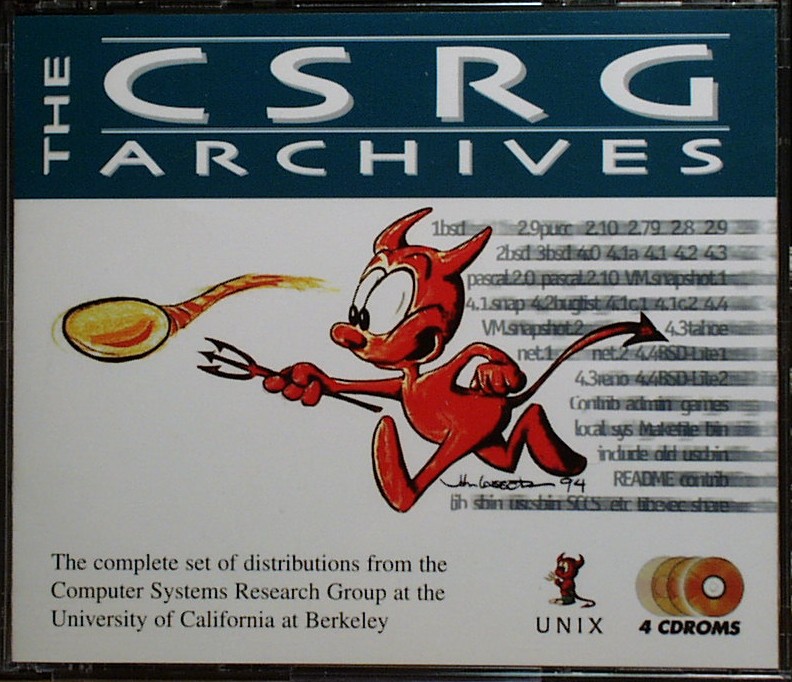
The whole set costs just under USD $100..
The government of the Republic of South Africa has published (( on the RSA Open Source Software in Government website )) the latest version (4.1) of its Minimum Interoperability Standards (MIOS) for Information Systems in Government, which now includes ODF as their document format:
The main thrust of the framework (in line with international best practice), is the adoption of a structured approach with regard to information systems. To achieve this approach, and to ensure the enhancement of interoperability across Government, a minimum set of standards are included in this document as a required Government-wide standard. To this end, this updated version of MIOS contains an explicit definition of Open Standards as well as the inclusion of the ISO (International Standards Organisation) Open Document Format.
It also says that they will consider open source software favourably for their IT systems:
In developing open information systems, open source based solutions are to be considered before proprietary ones
This is expanded upon in their new Policy on Free and Open Source Software use for South African Government, which codifies it as:
1) The South African Government will implement FOSS unless proprietary software is demonstrated to be significantly superior. Whenever the advantages of FOSS and proprietary software are comparable FOSS will be implemented when choosing a software solution for a new project. Whenever FOSS is not implemented, then reasons must be provided in order to justify the implementation of proprietary software.
2) The South African Government will migrate current proprietary software to FOSS whenever comparable software exists.
3) All new software developed for or by the South African Government will be based on open standards, adherent to FOSS principles, and licensed using a FOSS license where possible.
4) The South African Government will ensure all Government content and content developed using Government resources is made Open Content, unless analysis on specific content shows that proprietary licensing or confidentiality is substantially beneficial.
5) The South African Government will encourage the use of Open Content and Open Standards within South Africa.
They are also being reassuringly pragmatic about it, rather than dogmatic, as the justification says:
This is not to say that FOSS/OC solutions are currently available or appropriate in every situation or for every user, a reality accommodated in the revised policy.
So, all in all, quite a positive outcome!
I don’t know whether to laugh or cry over this one..
A company sues Cisco for infringing a patent. Just one problem, they filed the suit the day before the patent was granted!
It then appears they realise their faux pas and so persuade someone at the court to alter the docket to the day after, so it will match the patent issuance date!
With much thanks to the excellent Patent Troll Tracker blog for the news and to Dennis Crouch’s Patently-O blog for the complaint.
Props to Dennis Kaarsemaker for creating RSS feeds for changes to Ubuntu releases, such as the ones for Gutsy and the forthcoming Hardy Heron 07.10 LTS release!